The Anatomy of an AI Agent: Understanding the Architecture Behind Autonomous Systems
There’s a lot of mysticism around AI agents. Vendors promise “autonomous AI that handles your workflows,” but rarely explain what that actually means technically. If you’re evaluating these systems—or considering building one—you need to understand the architecture beneath the marketing.
Here’s the pattern that powers most production AI agents today.
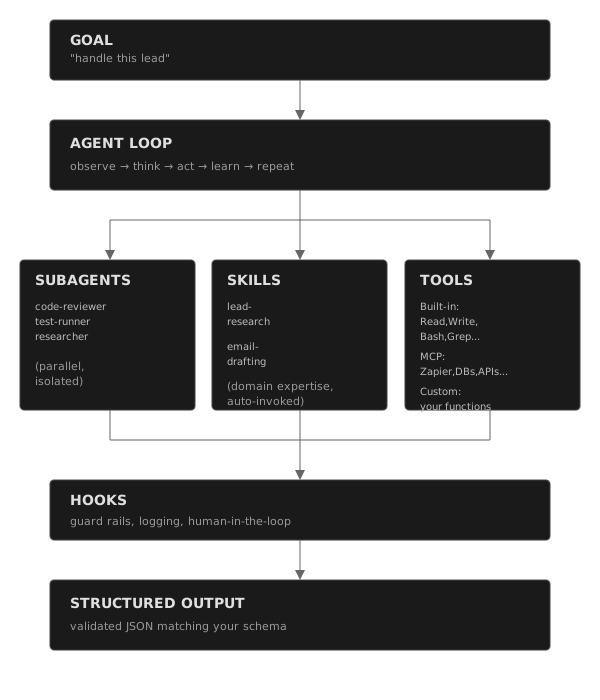
It Starts With a Goal
Every agent begins with a task prompt—a high-level objective like “handle this lead” or “process this support ticket.” The prompt is intentionally abstract. The agent’s job is to decompose it into actionable steps.
This is fundamentally different from traditional automation. You’re not scripting every decision. You’re defining an outcome and letting the system figure out how to get there.
That flexibility is both the power and the risk.
The Agent Loop: Observe, Think, Act, Learn
At the core of every autonomous agent is what researchers call the ReAct pattern—Reasoning plus Acting in a continuous loop:
Observe: The agent gathers context. What tools are available? What data exists? What happened in the last step?
Think: The agent reasons about what to do next. This is where modern language models shine—they can consider multiple approaches and select the most promising one.
Act: The agent executes something—calls a tool, spawns a worker process, retrieves information.
Learn: The agent updates its internal state based on results. Did that work? What should change for the next iteration?
Repeat: The loop continues until the agent determines the goal is complete.
This isn’t a single request-response. It’s an autonomous execution cycle that might run for seconds or hours depending on complexity.
The Three Capabilities Layer
Within that loop, agents have access to three types of resources that work in parallel:
Subagents
The orchestrator can spawn worker agents that operate independently. Each has its own context and specialized purpose. A lead-handling agent might spawn a researcher to look up company information, a qualifier to assess fit, and a writer to draft follow-up emails—all running simultaneously.
These workers are isolated from each other. They can’t see what the others are doing. They report back to the orchestrator, which synthesizes their outputs.
For complex workflows, this is where the real power lives. But it’s also where costs multiply—each subagent consumes its own computational resources.
Skills
Skills are reusable expertise bundles—documented best practices and specialized behaviors the agent can invoke. Think of them as institutional knowledge encoded in a form the agent can use.
Unlike tools, skills aren’t called explicitly. The agent recognizes when to apply them based on context. A sales-focused agent might have skills for lead qualification, objection handling, and proposal generation that activate automatically when relevant.
This is how you encode domain expertise into autonomous systems.
Tools
Tools are executable capabilities that interact with the external world:
- Built-in: Native capabilities like file operations and system commands
- Integrations: Connections to databases, APIs, and third-party services
- Custom: Your own functions exposed to the agent
Tools are how agents take action—not just think, but do. Query a CRM. Send an email. Update a database. Every meaningful interaction with the outside world happens through tools.
Hooks: The Control Layer
Here’s where responsible implementation separates from reckless experimentation.
Hooks are the safety and observability layer that wraps all agent actions:
Guard rails prevent dangerous actions. Don’t delete production data. Don’t spend more than $X. Don’t access these systems without approval.
Logging creates an audit trail. What did the agent consider? What did it decide? What did it actually do? When things go wrong—and they will—you need to understand why.
Human-in-the-loop pauses execution for high-stakes actions. Send this email to the CEO? Make this trade? Update this customer record? Some decisions should require human confirmation.
Without hooks, autonomous agents are liability machines. With proper hooks, they become reliable business tools.
Structured Output: Predictable Results
Agents don’t just “complete”—they produce typed, validated output conforming to a predefined schema.
This matters because downstream systems need to consume the results reliably. If your agent returns unstructured text, every integration becomes a parsing nightmare. If it returns validated JSON matching your schema, you can trust the format even when the content varies.
For a lead-handling agent, the output might include:
- Lead status (qualified, unqualified, needs-info)
- Company information gathered
- Recommended next action
- Draft communications
- Confidence scores
The schema defines what “done” looks like. The agent works until it can produce valid output.
The Complete Flow
Putting it together for “handle this lead”:
- Goal arrives: Handle incoming lead
- Agent loop activates: Observes lead data, thinks about information gaps
- Spawns subagents: Researcher looks up company, analyzer checks fit criteria
- Invokes skills: Uses lead-qualification expertise to assess
- Calls tools: Queries CRM, searches company website, drafts email
- Hooks intercept: Logs all actions, pauses before sending communication for approval
- Loop repeats: Until research complete, email approved, CRM updated
- Structured output: Returns validated result with status and next steps
Each iteration of this loop consumes resources. The art is minimizing loops while maximizing goal completion.
Why This Matters for Your Business
Understanding this architecture changes how you evaluate AI agent offerings:
Ask about the control layer. What hooks exist? How do you audit decisions? What happens when it goes wrong?
Ask about the skills. How is domain expertise encoded? Can you update it? How does the agent learn your business context?
Ask about the economics. Each subagent, each loop iteration, each tool call has a cost. What’s the actual resource consumption for your use cases?
Ask about the output. What schema does it produce? How do you integrate with your existing systems?
The vendors who can answer these questions clearly are the ones building real systems. The ones who retreat to vague promises about “AI magic” probably haven’t thought through the implementation.
At Sansoft, we design agent architectures tailored to specific business workflows—with appropriate guardrails for your risk tolerance and clear integration with your existing systems. The goal isn’t maximum autonomy. It’s maximum reliability within appropriate constraints.
That’s the difference between an impressive demo and a system you can actually trust.
Thinking through an AI decision?
We help mid-sized companies figure out what's worth building and how to build it right.
Schedule a Discovery Call